The exhibition, Dream Stream, at the China Pavilion at the 61st International Art Exhibition – La Biennale di Venezia opened on May 8. It is hosted by the Ministry of Culture and Tourism of the People’s Republic of China, with the Art Museum of the China Academy of Art (CAA) serving as the curatorial institution. Led by Professor Yu Xuhong, President of CAA and Director of CAA Art Museum, the curatorial team reveal the Eastern cultural lineages in the digital age.
Dream Stream (Mengxi) takes its name from Dream Stream Essays (Mengxi Bitan) by Shen Kuo, a scholar of the Northern Song Dynasty. Completed in the eleventh century, the Dream Stream Essays documents, in a notebook style, its author’s observations and reflections on the myriad phenomena of the natural world. It contains some of the earliest accounts of scientific phenomena such as the camera obscura and supernova explosions, alongside refined critiques of painting, calligraphy, and poetry. This mode of “observing things to investigate their underlying principles”, together with a cosmological vision of the “unity between humanity and the universe”, constitutes the distinctive intellectual and spiritual texture of the essay collection.
Titled Dream Stream, the China Pavilion takes stream as its guiding metaphor and dream as its experiential horizon. In dialogue with the introspective tone of the Biennale’s overarching theme In Minor Keys, it unfolds a poetics of fluidity to articulate a conversation between Eastern philosophy and contemporary art. Forging the past and present into a living site of art-science symbiosis, the exhibition uses natural imagery as its foundational vocabulary and transmedia expression as its mode of inquiry, allowing traditional sensibilities to be revitalized in the digital age.
When the Chinese classical triad of “Firmament, Earth, and Human” is transforming into a new existential framework: “Firmament, Earth, Human and Algorithms”, what role does art play? The integration of art and science opens new frontiers for creation and points toward the future. Breaking through conventional boundaries, the exhibition brings together calligraphy, moving image, installation, digital narrative, and cutting-edge technologies, highlighting such compelling moments as the philosophy of light and shadow, the unity of mind and brush, the meditative gaze across long handscrolls, and the interconnection between heaven and earth.
Black Myth: Wukong, produced by Game Science, makes its debut on an international art platform, presenting the sculpture Destined One, gameplay footage, hand-painted works, and the animated short videos Six Sentiments. The exhibition reveals how this game — winner of international accolades including Best Action Game at The Game Awards 2024 and Ultimate Game of the Year at the 2024 Golden Joystick Awards - redefine the benchmark of global action-adventure gaming.
The large-scale installation, 2027 Shen Kuo, created by the mega-project team of MSG, draws on the form of the long handscroll in traditional Chinese art. Using miniature models as its medium, it translates scientific content into an immersive installation, merging it into a landscape handscroll. The work measures 33 cm in height, 33 cm in depth, and 20 meters in length. Drawing on Under the Moon by Ma Yuan, it presents Shen Kuo in solitary contemplation amid mountains and rivers, gazing at the sky. Referring to Wanderer above the Sea of Fog by Caspar David Friedrich, it presents Joseph Needham’s pursuit of the history of science and technology in China. In dialogue with Gustave Doré’s illustrations for The Divine Comedy, it presents Academician Wang Jian’s contemplation of the Three-Body Computing Constellation. Three scenes, three eras, and three modes of “gazing” together form a dialectical structure of thesis, antithesis, and synthesis.
Along this deepening spiral, the exhibition further extends “the gaze of the age” into “connections across time and space”. The spatial installation, Liangzhu Highlight, co-created by artists Zheng Jing, Wu Junyong and their teams in collaboration with scientists from Zhejiang Lab, projects dynamic light from high above onto the ground. In the projected imagery, the simple and primitive symbols of Liangzhu are deeply intertwined with photoelectron tracks collected in orbit by the Cosmic X-ray Polarization Detector (CXPD) aboard the “Three-Body Computing Constellation”. “Highlight” originates from a key technique in Renaissance painting. It preserves the Liangzhu ancestors’ observation and expression of the universe while integrating contemporary technological exploration of the cosmos, achieving a spatiotemporal resonance between ancient civilizational imprints and cutting-edge scientific achievements.
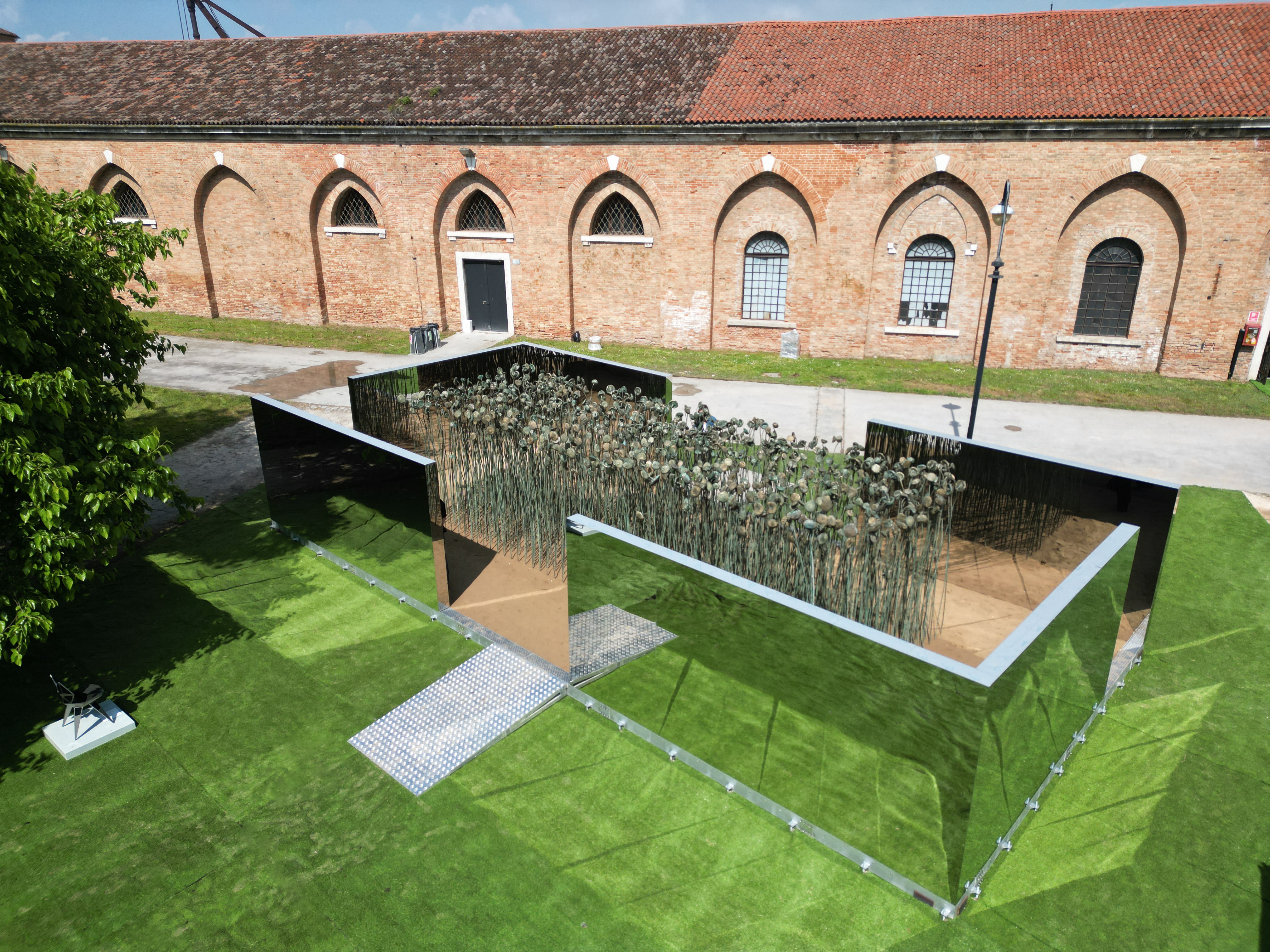
The account of the pinhole image recorded in Dream Stream Essays has also become an essential source of inspiration for this exhibition. In the outdoor sculptural installation Symbiosis, Xu Jiang intertwines bronze forms of upland sunflowers and aquatic lotus. Transcending their material distinctions, sunflowers and lotus come into symbiosis, offering a visual proposition for the potential of civilizational coexistence. The imagery of this sunflower-lotus symbiosis is projected indoors through camera obscura, creating an interface of light and shadow, where “shadow and the object diverge: when the object moves east, the shadow shifts west, and vice versa.” Through infinite reflections and endless symbiosis, the optical phenomenon described by Shen Kuo over a millennium ago is reactivated within the exhibition space in Venice, becoming a spatial meditation on perception, knowledge, and coexistence.
The title “Dream Stream” originates from the place visited by Shen Kuo in his dreams, and also resonates with the master calligrapher Wang Dongling’s enduring affinity with water. More than four decades of life by the West Lake have given him a deep appreciation of the idea that “the wise delight in water,” while the withering and renewal of the lake’s lotus flowers have, in turn, inspired his distinctive practice of “Chaos Script” (luanshu). On view in the exhibition is his monumental cursive work, Free and Easy Wandering, measuring 6.43 meters in height and 16 meters in width. The piece draws on Zhuangzi’s parable of the kunpeng, a mythological beasts that metamorphoses from a giant fish into a bird: “striking the waters for three thousand li and soaring upward ninety thousand li on the whirlwind.” The exhibition also introduces a robotic system jointly developed by the Design Innovation Center for Robotic Aesthetics and Human Factors Engineering at CAA and Astribot. The robot imitates Wang Dongling’s calligraphic style to write the Chinese characters for “Dream Stream.” As art and technology share the same brush, mind and hand align, allowing the dream to take form in ink and the stream to flow.
Move further into the exhibition, Yang Fudong’s latest creation, Solitary Hill, Plantain Rain, will come into view.It is a multi-panel installation composed of twenty individual images that integrates acrylic painting, black-and-white photography, and videos. The acrylic paintings draw inspiration from the Northern Song masterpiece, Elegant Gathering in the Western Garden (Xi Yuan Ya Ji Tu), while the black-and-white photographic component centers on bamboo groves and banana leaves, translating visual motifs from traditional painting into a contemporary photographic language. By juxtaposing “Solitary Hill” and “Plantain Rain,” Yang Fudong not only pays homage to the reclusive traditions associated with Solitary Hill since the Song dynasty, but also, through a cross-media contemporary approach, evokes a dreamlike realm for quiet contemplation and wandering beyond the mundane.
Having toured the exhibition, Italian Deputy Prime Minister and Minister of Infrastructure and Transport Matteo Salvini said he admired Chinese culture and praised the exhibition as “wonderful”, noting that it showed both China’s historical culture and its vision for the future. After receiving a robot-written calligraphy work of “Dream Stream,” he said he liked the fragrance of Chinese ink and would place the work in his office.
Laura Fincato, former Italian deputy foreign minister, said the China pavilion reflects openness, dialogue and connection, as well as the creativity of the artists. She said art and culture plays an important role in building bridges when the world needs more communication and mutual understanding.
Pietrangelo Buttafuoco, President of La Biennale di Venezia, traced the origins of this exhibition back to 2024, when the Biennale had already embarked on a journey following in the footsteps of Marco Polo. On November 9, 2024, the exhibition The Perfect Path – Hangzhou, Marco Polo’s ‘City of Heaven,’co-organized by the CAA and La Biennale di Venezia, opened at the CAA Art Museum, a National Key Art Museum of China. Italian President Sergio Mattarella made a special trip to visit the exhibition and offered high praise: “This is a perfect exhibition, and your academy is a remarkable institution.” From CAA, countless distinguished artists and architects have emerged and grown.
Yu Xuhong, President of CAA, Director of CAA Art Museum, and curator of the China Pavilion, noted that out of respect for the historic architecture, the curatorial team constructed a 1:1 spatial replica at the Xiangshan Campus of CAA in Hangzhou, where they meticulously rehearsed the exhibition layout and refined the quality of each artwork. Today, the China Pavilion has achieved a distinctive display effect that evokes both “camera obscura and camera lucida”—a poetic site where reality and illusion intertwine. He hopes that visitors to the China Pavilion will engage face to face, heart to heart, with the poetry and charm of Chinese culture, experience the creativity and vitality of contemporary Chinese art, and come to appreciate the tension and warmth of art in the age of AI.
This is a time of uncertainty. Art exists within the spiritual world where people enter into dialogue and hearts resonate across cultures, beneath a vast sky that transcends time and national boundaries. Through the revitalisation of enduring traditions and growth rooted in local soil, art journeys across the expansiveness of the world, breathing in its vitality–an experience that is profoundly precious.
This is a time of uncertainty. Art inhabits the living world of spirit, empathy, and compassion, within a reality where chaos intertwines with hope. Art finds value in overcoming adversity and awakening a sense of optimism. It is equally precious to walk through the jungle of life in search of a Lichtung.
This is a time of uncertainty. Art unfolds in a virtual world of fragmented information and technological mediation, within an ecosystem of human and artificial intelligence. To liberate oneself from algorithmic determination and embrace an inspired encounter with the future–exploring the cosmic imagination at the confluence of culture and technology–this remains uniquely precious.
In Chinese oracle-bone script, the character yi (艺, art) depicts a half-kneeling human figure planting grain. This pictographic origin embodies a profound reverence for the land and conveys respect and devotion towards artistic practice. In ancient Greek mythology, Athena, the goddess of the arts, is often depicted with owl-like eyes, keen and luminous, capable of piercing through darkness to perceive the light. These ancient imaginaries from two civilizations point to a shared essence of art: to seek the force of growth amid uncertainty, and to pursue a penetrating light in moments of obscurity. In Venice, a city shaped by centuries of encounters between Eastern and Western civilizations, Dream Stream unfolds as a conversation across time and space: on how tradition may be renewed, how the integration of art and science can generate new energies, and how different civilizations might seek symbiosis through their differences.